
Son Detained by ICE, Family Seeks Legal Help

A living database documenting reported immigration enforcement incidents and their human impact.
We collect individual stories of people impacted by U.S. immigration enforcement from news reporting, court records, and community accounts into one searchable public database, updated daily and reviewed by our team. The Human Impact Project is run by the Human Security Initiative, a 501(c)(3) nonprofit.
A 22-year-old from Guatemala was walking to his job as a vegetable grocer in the Sunset Park neighborhood of Brooklyn when six ICE officers approached him on the street. The officers showed him photos of men and asked, "You're Latino, you look like one of them. Do you know any of these guys?" When he said no and was asked for identification and papers, he gazed at their firearms and felt he had no choice but to respond. The officers then arrested him. In ICE's account, agents claimed they "noticed a person matching the target's biographic information wearing a hooded jacket."

In early February 2026, ICE agents conducted a stakeout operation in Port Richmond, Staten Island, searching for a specific target but mistakenly arrested at least three men who were not the intended subjects. Isaias, 36, from Guatemala, was arrested while agents were looking for a different 25-year-old man from Mexico named Julio. Juan, 21, also from Guatemala, was arrested during the same operation; he had lived in the U.S. for nearly two decades and has two U.S. citizen children. Alejandro, 47, from Mexico, was arrested after leaving a location agents were staking out. Following their arrests, both Isaias and Juan decided to leave the country according to federal court records. Alejandro and Juan both had habeas petitions filed by lawyers challenging the legality of their detention, with a judge ordering Alejandro's release and Juan later being released after filing his petition.
Diego, from Ecuador, was surrounded by three ICE agents as he sat in his vehicle in February. He cried out for help ("¡Auxilio! ¡Ayúdenme!"), which drew a neighbor to her window. The neighbor witnessed the arrest and partly captured what happened on her phone. When Diego emerged from the vehicle, his face was bloody.
Harold, a 58-year-old Cuban national, was deported to Mexico in February 2026 as part of the third-country deportation program. He finds himself unable to work due to lack of documentation, unable to afford food and rent, and without clear prospects for legal status or support.
Lázara Santana, 57, migrated to the United States from Cuba at age 11. She lost her refugee status 20 years ago for selling drugs. For two decades she checked in annually with Immigration and Customs Enforcement under parole conditions and held work permits while raising her son, a U.S. Marine who served in Afghanistan and voted for Trump. In fall 2025, ICE took her into custody at a check-in and deported her to Mexico, where she was given the choice of Congo or Mexico. She now rents a shared room with money sent by her partner and fears leaving her house.
Mauricio De Leon, 50, was born in Guatemala and taken to the United States by his mother at age one. He grew up in the foster system in Long Beach after his mother lost custody. Given a deportation order in 2007 after serving time for drug trafficking, he was deported to Mexico last year. Mexico attempted to return him to Guatemala, but Guatemala said it had no record of him, leaving him essentially stateless. He survives on savings from his work as a truck driver in California.
Ricardo del Pino Olivera, 67, was deported from the United States to Mexico on July 3, 2025 after serving a 17-year sentence. He applied for refugee status on July 31 but struggled to find formal employment or access services. After the Amparito shelter in Villahermosa advocated on his behalf, he received some medical treatment but was repeatedly hospitalized beginning December 12. He was severely malnourished and remained without legal documentation. Ricardo died on February 21, 2026. His death certificate listed his nationality as "unknown."
Luis René Lemus, 59, a Cuban with Parkinson's disease and schizophrenia, was deported to Mexico where he has struggled to procure needed medication. He is among elderly and infirm Cubans sent to Villahermosa under the third-country deportation program.
Ricardo Pérez, 67, a Cuban, was pushed across the U.S. border by immigration agents while in a wheelchair and deported to Mexico. He arrived at a Catholic shelter in Villahermosa among many elderly Cubans with health problems, where he struggles to access care and necessities.
Nikita and Oksana, a Russian couple who fled Russia and requested asylum at the Otay Mesa port of entry in October 2025, were detained with their three children, ages 4, 12 and 13, at Dilley Immigration Processing Center for over four months, despite a federal court limit of 20 days for detaining minors. An asylum officer found the family had credible fear of persecution based on Nikita's activism against the Russian government. During detention, the children faced worms and mold in their food, inadequate medical care, and lights that never fully dimmed; 12-year-old Kamilla developed partial hearing loss after a poorly treated infection, 13-year-old Kirill developed anxiety and panic attacks and became suicidal after staff wrongly told the family they could leave and they spent $1,500 on plane tickets before being told they could not depart, and 4-year-old Konstantin became frightened of guards. They were released a day later with new tickets, but remained in detention until February 2026, when they were freed about a week after their attorney sought their release on medical grounds and five days after NBC News reported on their conditions; DHS had said it was legally required to hold the family pending their asylum claims but did not explain its reversal. Upon release, Kirill said he wanted a Subway sandwich, Kamilla wanted sushi, and Konstantin hoped to be reunited with a stuffed animal confiscated during detention, while their parents said they most wanted to feel safe at home.
An Angolan woman with an active immigration case pending in court was arrested while taking her 6-year-old daughter to school and detained at Dilley Immigration Processing Center. Upon release in mid-February 2026, she was given a court summons to appear near her original arrest location but was transported to Laredo, Texas—over 2,200 miles away from her home in Maine. The family faced difficulties accessing transportation to return home.
During ICE's Operation Metro Surge in Minnesota, Isabel, a 41-year-old Honduran woman with a pending asylum case and valid five-year work permit, was arrested at her monthly immigration check-in in Bloomington and detained for four days across three locations. After a federal judge ordered her release, she was given back a mostly empty bag missing her work permit, state ID, daughter's passport, and two uncashed checks worth over $700. Immigration lawyers report this is a widespread pattern: one attorney estimates 35 of her clients lost documents in detention, with another describing it as "more the rule than the exception" that people are not returned their belongings. A federal judge found a Trump administration attorney in civil contempt of court for failing to return documents to another detainee, Rigoberto Soto Jimenez, and imposed daily fines until documents were returned via overnight mail. The seizure and non-return of documents from people not in removal proceedings affects immigrants with work permits, pending visas, U-visas, and refugees with legal entry status.

Linet Vartanniavartanians, a naturalized U.S. citizen, and her husband Mehrzad Asadi Eidivand, an undocumented Iranian national, were arrested in June 2025 when HSI agents executed a warrant at their Tempe, Arizona home. Vartanniavartanians called 911 and threatened to shoot the agents if they entered; Eidivand possessed firearms as an undocumented immigrant. Both pleaded guilty and were released with time served and two years' probation in late November 2025. However, Eidivand was immediately re-detained by ICE and held at Imperial Regional Detention Facility in Calexico for three months. His attorney reports ICE has pressured him to sign a deportation order to Iran without legal representation, despite him facing an execution order there due to his opposition to Iran's Islamist regime. The attorney believes ICE is retaliating against the family over his brother's hunger strike in immigration detention.

Roberto, a Cuban man, was deported to Mexico in mid-February 2026 after being detained at an immigration appointment where he was informed his I-220A form was invalid. He was held for three weeks before being transferred to Tapachula without money, identification, or communication access. His U.S. citizen fiancée in Michigan eventually reconnected with him and traveled to deliver documents so they could marry. Roberto now works as a barber in Cancún while awaiting a spousal visa determination.
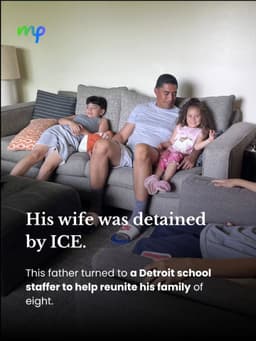
Osmary Garcia, who entered the U.S. legally through the CBP One app during the Biden administration, was detained by immigration officers in February 2026 after dropping her children off at school, and held for three months before agreeing to voluntary departure. After the Trump administration revoked legal status for CBP One entrants and ended the asylum program under which the family had been admitted, her husband Hector Marin and their six children, who had not lived in Venezuela in nine years, joined her there with help from Detroit Public Schools staffer Kristen Plonsky. Two weeks after the family reunited, two major earthquakes devastated the region, leaving the children traumatized by the destruction.
Prince Sita Armel Paterne, a priest from the Congo, was detained by ICE in February 2026 after mistakenly taking the wrong exit while driving to work, which led him to the Canada border where he was arrested. An immigration judge set a $10,000 bond for his release on May 19, 2026. His family was unable to assist financially, prompting a fundraiser to prevent his deportation.

An Iranian couple seeking asylum was detained and interrogated by DHS agents less than a week after U.S.-Israeli military strikes against Iran in late February 2026. The husband, who arrived on a tourist visa in November 2024 and filed for asylum after his visa expired, was held for three weeks at an ICE detention facility in California City before an immigration judge granted his release on bond. His pregnant wife was questioned but not arrested. Immigration attorneys report the incident reflects a broader pattern of heightened scrutiny of Iranians following the strikes.

An Indonesian citizen with withholding of removal status was detained at an airport and transferred to Adelanto Detention Facility in February 2026 after almost 18 years of compliance with his Order of Supervision. He was not told why his supervision was being revoked or given an opportunity to address allegations. The court granted his TRO application and ordered his immediate release.
An Iranian man seeking asylum was detained by ICE agents at his apartment less than a week after U.S.-Israeli military strikes against Iran in late February 2026. The couple had entered the U.S. legally on tourist visas in November 2024, filed for asylum after receiving threats from the Iranian government, and held pending asylum applications with work permits. The husband spent three weeks at the ICE detention facility in California City before an immigration judge granted his release on bond. His pregnant wife was questioned for hours but not arrested due to her pregnancy.

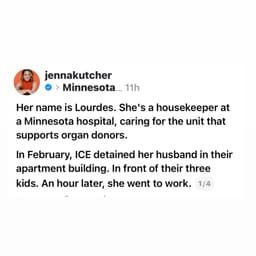
An ICE enforcement action resulted in the detention of a father in Hopkins, Minnesota, in front of his three children at their apartment building. The incident disrupted the family, with his wife Estefany Escobar going to work at a Minnesota hospital an hour after the arrest.
Showing 20 of 5167 incidents