
U.S.-born Latino man detained by ICE while walking as autistic son watched

A living database documenting reported immigration enforcement incidents and their human impact.
We collect individual stories of people impacted by U.S. immigration enforcement from news reporting, court records, and community accounts into one searchable public database, updated daily and reviewed by our team. The Human Impact Project is run by the Human Security Initiative, a 501(c)(3) nonprofit.
Prisciliano Trejo, 29, died from acute leukemia days after Jesus Manuel Arenas Silva's death in ICE custody. His family said detention officials delayed urgent medical treatment despite his repeated complaints of severe symptoms.
Seven plaintiffs who were detained in ICE custody for civil immigration purposes filed suit against the U.S. Department of Homeland Security after the agency failed to return their seized property, including Employment Authorization Documents, cell phones, and car keys, more than four months after their release. The lawsuit, brought on behalf of the named plaintiffs and a class of similarly situated individuals, alleges the losses cost them work opportunities and left them afraid to go out in public without identification for fear of being detained again. The case argues ICE has adopted a de facto policy of failing to return property once its legitimate governmental interest in the items has expired, violating the Fourth Amendment and the Administrative Procedure Act.

Orville Etoria, a 62-year-old Jamaican man with legal U.S. permanent residence, was deported to Eswatini in July 2025 despite having completed his prison sentence and complied with ICE supervision requirements. After his 2021 release, he lived in New York, earned a master's degree in theology, worked at a men's shelter, and regularly reported to ICE. When ICE asked him to obtain a Jamaican passport, he complied but was instead sent to Eswatini rather than Jamaica, leaving his family without knowledge of his whereabouts for days and his attorneys unable to reach him. Jamaican officials said the country does not refuse repatriation of its nationals. In a later deposition, Etoria described being held in extreme isolation for two and a half weeks at Matsapha Correctional Complex, a maximum-security prison, barred from outside contact and confined to his cell except for meals, saying guards treated detainees 'as if we were violent, even though we had done nothing wrong.'

In November, immigration agents took an 18-year-old U.S. citizen off the street and eventually left him in the woods.

Tesfay T., a 35-year-old Ethiopian man who had been imprisoned and tortured in Ethiopia and later kidnapped and tortured again in Mexico, fled to the United States and spent more than a year in immigration detention after crossing the border irregularly. An immigration judge denied his asylum claim but granted him 'withholding of removal' because of the likelihood he would be tortured again if returned to Ethiopia. In February 2026, while his lawyer was pursuing a habeas corpus petition for his release, an ICE officer told him to sign a voluntary departure form and said, 'I don't care, I'm going to sign it myself' when Tesfay refused and asked to speak with his attorney. He was then flown to Cameroon chained at his wrists, legs, and stomach for the entire journey, denied the ability to stand or use a bathroom without restraints, and was not told his destination until after landing.

Eber, a two-year-old U.S. citizen, remains in Mexico in the care of María Estela Díaz and Miguel Maldonado Mendoza after his father was deported to Venezuela in early 2024 and his mother that February. The couple took him in because he needed surgery to remove half of his left lung due to a cyst and could not travel with his seven-year-old brother Isaac, who joined their parents months later. The surgery was successful and Eber has recovered well, though Díaz and Maldonado have faced financial strain covering his care and have turned to GoFundMe campaigns for support. His mother has registered the case with Venezuela's 'Gran Misión Vuelta a la Patria' program to speed up consular processing, but the family still has no confirmed date for the visa Eber needs as a U.S. citizen to enter Venezuela. Díaz said Eber no longer recognizes his biological mother and now calls her and Maldonado 'mama' and 'papa.'

José Esteban, a husband and first-time father, was detained by ICE on August 15 while working to support his family. He had entered the United States legally with a visa, hoping to build a better life. His wife, Jeudyz, is now caring for their newborn son, Agustin, alone while dealing with the emotional and financial strain of his detention, and the family is raising funds to cover rent, household expenses, and legal fees.

The Department of Justice filed denaturalization actions against 40 naturalized U.S. citizens, accusing them of concealing "serious offenses" during the naturalization process, including acting as an agent for a foreign government, voluntary manslaughter, and aggravated sodomy against a special-needs man. Attorney General Todd Blanche called it "the largest denaturalization effort in modern history," and Assistant Attorney General Brett Shumate said the individuals "lied their way into U.S. citizenship." The 40 people originally came from countries including Mexico, Colombia, Pakistan, Haiti, Nepal, and Ghana, part of a broader push that has targeted hundreds of naturalized Americans for denaturalization this year.
Phone Chomsavanh, a Laotian citizen who was born in a refugee camp in Thailand and moved to the U.S. with his family at age 7, was released from Eswatini's maximum-security Matsapha Correctional Complex on Sunday after being held there for more than 14 months. He was deported to Eswatini in July 2025 under the Trump administration's third-country deportation program after already completing his U.S. prison sentence, one of five immigrants sent there at the time. His lawyer, Tin Thanh Nguyen, said he was given no notice, hearing, or chance to object before being flown to a country he had no ties to, saying, 'He had already served his time. Instead they put him on a plane without telling him where it was headed and left him in a prison in a country he had never heard of, where nobody ever accused him of anything.' Following his release, he traveled through Johannesburg en route to Laos. The third-country deportation program has sent about 500 immigrants to African nations that are not their countries of origin, with Eswatini receiving roughly 30 people under an agreement with the U.S. in exchange for $5.1 million in payments.

A 26-year-old refugee known only as Adam, who fled forced military conscription, was granted protection from removal by a US immigration judge but was secretly deported to Equatorial Guinea in November 2025 under a third-country removal deal. He has been confined alone in a hotel room under armed guard for nearly a year, and was recently handcuffed and beaten by security officers who warned him not to speak out.
Lianyong Wei, a 51-year-old Chinese national who had lived in Saipan since entering the U.S. in 2019 on a two-week parole authorization, died in ICE custody at the Northern Mariana Islands Department of Corrections. Local police had arrested Wei on August 21, 2026, on criminal charges including an alleged attack on a family and assault with a dangerous weapon, and he was transferred to ICE custody the next day to face removal proceedings. He was found dead with a bedsheet tied to his bunk and around his neck, with reports differing on whether he was discovered unresponsive during a routine morning check less than a day after entering custody or two days later; resuscitation efforts at a hospital failed. It remains unclear whether he received a required medical intake screening. Corrections Commissioner Anthony Torres extended condolences to Wei's family and said the department is reviewing its procedures. His cause of death remains under investigation, and the Chinese Consulate General in Los Angeles has demanded a thorough inquiry, noting he is at least the fifth Chinese national to die in ICE or Border Patrol custody since March 2025. His death has been recorded among dozens of detainee deaths reported by ICE since 2025.
D.C., a 62-year-old Dominican citizen who entered the U.S. without authorization, has been held by ICE since September 2025 after completing a state prison sentence tied to a 1998 drug conviction, along with earlier convictions for possessing a forged instrument, a domestic assault, and criminal contempt. A district court ordered that he receive a bond hearing under Second Circuit precedent requiring hearings when mandatory detention becomes 'unreasonably prolonged,' but denied his request for immediate release. The Supreme Court has now agreed to hear the Trump administration's appeal in the case, Genalo v. D.C., to decide whether the government must prove by clear and convincing evidence that he poses a flight risk or danger to remain in custody; the case is part of a broader dispute over a July 2025 policy mandating detention for immigrants in deportation proceedings.
Adwoa, a 21-year-old bisexual woman from Ghana, fled years of violence and ostracism after neighbors accused her family of witchcraft over her sexuality. Despite obtaining a US court guarantee that she would not be deported back to Ghana, she was instead sent to Cameroon earlier this year, where same-sex relations are illegal and punishable by up to five years in prison. She has been held at a government-run detention facility in Cameroon for several months, describing her situation as feeling like "a criminal" and fearing she could be killed if returned to Ghana.

A federal judge in Maryland, Stephanie Gallagher, has now held the Trump administration in contempt twice in two months in the same case over the repeated deportation of a young asylum seeker identified in court documents as E.L.A. He was first deported in March 2026 after missing two biometrics appointments, even though U.S. Citizenship and Immigration Services never formally closed his asylum case as is standard practice. After being returned to the U.S. in August 2026 to pursue his claim, he was deported again on September 1, just three weeks after DHS issued internal guidance meant to prevent such removals, violating a third court order. His attorneys said he was left in El Salvador without his belongings, money, or a phone, still wearing a detention jumpsuit; the case stems from a 2019 class-action lawsuit, J.O.P. v. DHS, protecting the asylum rights of immigrants who arrived in the U.S. as unaccompanied minors.

José Alejandro Aponte, a 65-year-old Cuban man deported from the United States to Villahermosa, Mexico, stayed briefly at the Amparito Shelter and now rents a small room in the city center. When Forbidden Stories spoke with him in spring 2026, he had just been refused residency in Mexico. "I tried to comply with every rule. Now I'm in immigration limbo. I have no papers to go anywhere," he said, adding that he fears losing contact with his family because phone companies now require numbers to be linked to a valid identity document.
Humberto García, a Cuban national deported to Mexico after living 35 years in the United States, tried to travel through the mountains near Tapachula to avoid migration checkpoints. He was approached by three armed attackers who robbed him and shot him twice in the torso; he stumbled for nearly an hour before reaching a road where authorities took him to a hospital. After three days recovering, with no organ damage from the bullets, he had no choice but to return to Tapachula, where he said he was left with nothing to eat and nowhere to sleep.

Yeferson Francisco Sequera Ruiz, a 31-year-old immigrant from Venezuela, was arrested by U.S. Immigration and Customs Enforcement and is being held in a Texas detention center. According to immigration, state and federal court records, he has no criminal convictions and is facing deportation.

Angel Arellano, 17, has taken on multiple jobs after his father, Adrian Enriquez, was detained by ICE and deported to Mexico in May following more than 25 years living in the United States. Angel now wakes around 5 a.m. to work at a welding shop before school, works with his father's former maintenance crew after classes, and washes dishes and busses tables at a restaurant in the evenings. He gave up playing football to help his older brother support their two younger brothers, ages 16 and 11, and at one point offered to drop out of school entirely to work full-time. Enriquez said from detention, 'What hurts the most is seeing them work so much.'

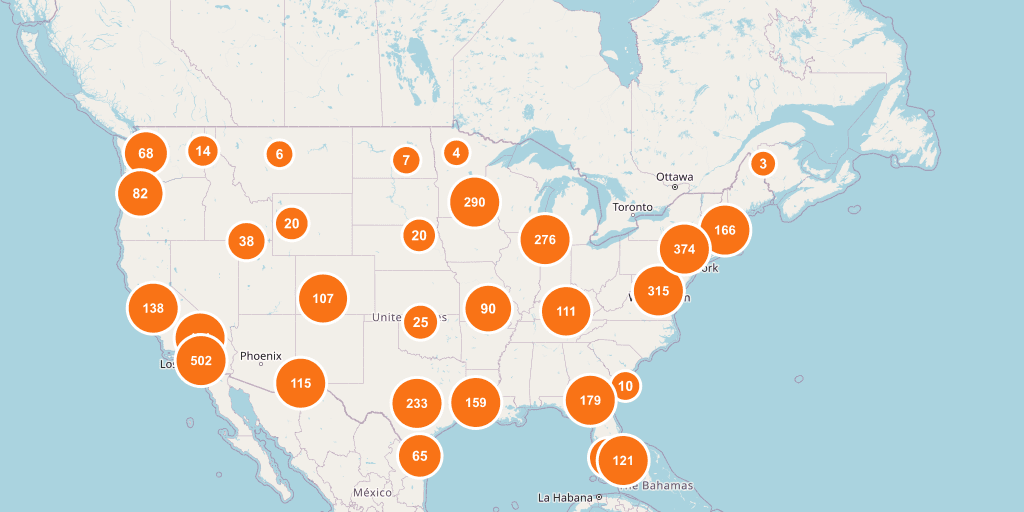
Showing 20 of 525 incidents